


A couple of weeks ago I nearly froze my toes off testing the waterproof Pentax Optio WPi, so this week I thought I’d have an easier time with its non-amphibious sibling the Optio S6. Unfortunately our wonderful British weather had other ideas. This time I froze the rest of my body, and wished that I was as waterproof as the WPi. Anyone who tells you we’re having a mild dry winter is lying through their teeth. It’s cold and wet out there, and has been all week.
 Over the past three years, the six consecutive models that have comprised Pentax’s Optio S range of tiny sub-compact digital cameras haven’t really changed much. From the original 3.0MP Optio S launched in January 2003, to the S5z launched in May last year, the only real changes have been the ever-increasing size of both the CCD and the LCD monitor. The range of features on offer, the menu, power, exposure and autofocus systems, the 3x zoom Sliding Lens System optics and even the size and shape of the case have all remained virtually unchanged from one camera to the next, with only slight tweaks here and there. A camera design that was ahead of its time three years ago was beginning to look dated, and its performance was starting to lag behind the competition. It was clearly time for a change.
 This change has appeared in the form of the Optio S6, the latest in the series. Competitively priced at £229.99 on the high street or as low as £189.99 online, at first glance it looks very much like all the other cameras in the S series. It is extremely compact, with the same well made all-metal body and flush fitting lens. It even has the same concentric circle texture on the front panel. However, although the S6 looks quite similar to its immediate predecessor the S5z, it is a very different camera both inside and out. It still has a 3x optical zoom lens that folds into itself leaving a camera just 19mm thick, but this isn’t the same lens as on previous models. It is a new design which is smaller, lighter and extends much more quickly at power on. Previous Optio S models have been getting a bit slow on the start-up, but thanks to the new lens design and an improved power system, the S6 now takes just 2.5sec to power up. There are a few faster cameras around, but this is better than most.
 Another familiar looking feature is the big 2.5in LCD monitor, but this too is vastly improved. It is low-reflection with exceptionally high 232,000 pixel resolution and a particularly fast refresh rate, which means that the scene you see on the monitor doesn’t lag behind movements of the camera.
One thing that hasn’t changed much is the control layout and menu system, but then the previous Optio S system was very good already. The selection process for flash modes and focus modes has received a bit of a tweak though, and these are now selected from a list rather than just cycling through the available options.
 There are plenty of focusing options to chose from, with pan focus, infinity focus and 25-step manual focus available, as well as macro mode although with a minimum range of 15cm this is not terribly impressive. The focus area mode can be selected in the menu, but sadly the frame-wide selectable AF point is no longer an option, but it has been replaced with an active tracking AF, ideal for shooting moving subjects.
The S6 features the same Green Button as on previous models, which operates as a user-definable function button, giving quick access to four commonly-used options via the D-pad. The defaults are resolution, ISO, white balance and exposure compensation, but any of the other menu adjustments can be mapped onto it, including image quality, focus area, metering mode, contrast, saturation and sharpness.
Although like the rest of the Optio S range the S6 has no manual exposure controls, it does have a good selection of scene modes, although fewer than on some previous models. These options include night scene, landscape, flower, portrait, candlelight, surf & snow, sport, pets, text copying, food and the unintentionally hilarious frame composite mode, in which a delightful decorative frame is added to your shot. Choose from a lovely lacy heart, a border of roses and daisies, or a frame of film with a cartoon character saying “How nice!!” I couldn’t put it better myself.
Also on the mode menu is the movie mode. It shoots at the now essential 640 x 480 resolution at 30 frames per second, however unusually it stores clips in the ultra-compact DivX format.
 Inside the S6 is a new 6.36MP CCD sensor (6.0 effective), as well as a new faster exposure and autofocus system. It is also equipped with an AF illuminator, which I found would provide a focus lock in total darkness at a range of about 3 metres.
Also useful for low-light shooting is an exceptionally powerful built-in flash, with an effective range of over 5m at wide angle, or 2.7m at telephoto. Flash metering is also very good, providing just the right amount of fill-in flash even at quite close range. Colour balance and coverage were also very good.
This brings us neatly to the crux of the issue; picture quality. Previous Optio S models have generally produced very good picture quality. Not perhaps the best available, but certainly well above average. Each successively more powerful model has improved on the last, so does the 6 megapixel S6 continue the trend? Happily, the answer is yes.
The Optio S6 is capable of the highest image quality of the series so far, although I will have to qualify that. In order to get the best out of it, you need to make a few adjustments. Shooting in the appalling weather over the past week, I’ve found that the automatic ISO setting has a great fondness for selecting 400 ISO at the slightest provocation, leading to many pictures being ruined by excessive image noise. However by manually setting either 64 or 100 ISO and just holding the camera more steadily it was possible to get much better results in the same conditions.

Read More...
Over the past three years, the six consecutive models that have comprised Pentax’s Optio S range of tiny sub-compact digital cameras haven’t really changed much. From the original 3.0MP Optio S launched in January 2003, to the S5z launched in May last year, the only real changes have been the ever-increasing size of both the CCD and the LCD monitor. The range of features on offer, the menu, power, exposure and autofocus systems, the 3x zoom Sliding Lens System optics and even the size and shape of the case have all remained virtually unchanged from one camera to the next, with only slight tweaks here and there. A camera design that was ahead of its time three years ago was beginning to look dated, and its performance was starting to lag behind the competition. It was clearly time for a change.This change has appeared in the form of the Optio S6, the latest in the series. Competitively priced at £229.99 on the high street or as low as £189.99 online, at first glance it looks very much like all the other cameras in the S series. It is extremely compact, with the same well made all-metal body and flush fitting lens. It even has the same concentric circle texture on the front panel. However, although the S6 looks quite similar to its immediate predecessor the S5z, it is a very different camera both inside and out. It still has a 3x optical zoom lens that folds into itself leaving a camera just 19mm thick, but this isn’t the same lens as on previous models. It is a new design which is smaller, lighter and extends much more quickly at power on. Previous Optio S models have been getting a bit slow on the start-up, but thanks to the new lens design and an improved power system, the S6 now takes just 2.5sec to power up. There are a few faster cameras around, but this is better than most.Another familiar looking feature is the big 2.5in LCD monitor, but this too is vastly improved. It is low-reflection with exceptionally high 232,000 pixel resolution and a particularly fast refresh rate, which means that the scene you see on the monitor doesn’t lag behind movements of the camera.One thing that hasn’t changed much is the control layout and menu system, but then the previous Optio S system was very good already. The selection process for flash modes and focus modes has received a bit of a tweak though, and these are now selected from a list rather than just cycling through the available options.
There are plenty of focusing options to chose from, with pan focus, infinity focus and 25-step manual focus available, as well as macro mode although with a minimum range of 15cm this is not terribly impressive. The focus area mode can be selected in the menu, but sadly the frame-wide selectable AF point is no longer an option, but it has been replaced with an active tracking AF, ideal for shooting moving subjects.The S6 features the same Green Button as on previous models, which operates as a user-definable function button, giving quick access to four commonly-used options via the D-pad. The defaults are resolution, ISO, white balance and exposure compensation, but any of the other menu adjustments can be mapped onto it, including image quality, focus area, metering mode, contrast, saturation and sharpness.
Although like the rest of the Optio S range the S6 has no manual exposure controls, it does have a good selection of scene modes, although fewer than on some previous models. These options include night scene, landscape, flower, portrait, candlelight, surf & snow, sport, pets, text copying, food and the unintentionally hilarious frame composite mode, in which a delightful decorative frame is added to your shot. Choose from a lovely lacy heart, a border of roses and daisies, or a frame of film with a cartoon character saying “How nice!!” I couldn’t put it better myself.
Also on the mode menu is the movie mode. It shoots at the now essential 640 x 480 resolution at 30 frames per second, however unusually it stores clips in the ultra-compact DivX format.
Inside the S6 is a new 6.36MP CCD sensor (6.0 effective), as well as a new faster exposure and autofocus system. It is also equipped with an AF illuminator, which I found would provide a focus lock in total darkness at a range of about 3 metres.Also useful for low-light shooting is an exceptionally powerful built-in flash, with an effective range of over 5m at wide angle, or 2.7m at telephoto. Flash metering is also very good, providing just the right amount of fill-in flash even at quite close range. Colour balance and coverage were also very good.
This brings us neatly to the crux of the issue; picture quality. Previous Optio S models have generally produced very good picture quality. Not perhaps the best available, but certainly well above average. Each successively more powerful model has improved on the last, so does the 6 megapixel S6 continue the trend? Happily, the answer is yes.
The Optio S6 is capable of the highest image quality of the series so far, although I will have to qualify that. In order to get the best out of it, you need to make a few adjustments. Shooting in the appalling weather over the past week, I’ve found that the automatic ISO setting has a great fondness for selecting 400 ISO at the slightest provocation, leading to many pictures being ruined by excessive image noise. However by manually setting either 64 or 100 ISO and just holding the camera more steadily it was possible to get much better results in the same conditions.
Apart from that hitch, colour rendition, exposure and focusing were spot on in virtually all conditions, and with the faster AF system more shots were in focus.
All in all, the S6 is a good continuation of a popular and innovative line of digital cameras. It corrects all the weaknesses of previous models, and with its improved performance and image quality it makes a perfect pocket snapshot camera.
Verdict

 The W10 is superficially similar to the WPi in both design and specification. It too features a six megapixel CCD and 3x optical zoom non-protruding lens, and is waterproof to a depth of 1.5m for up to 30 minutes. With a high street price of £249.89 it is actually £20 cheaper than the launch price of the WPi, which is probably going to annoy anyone who bought that camera when it came out, especially since you can now buy a WPi in the high street for just £175.
 The main differences are internal, and they are much more than superficial. The WPi is based on the internal workings of the Optio S6, and although that is a great little camera it isn’t exactly the fastest thing around. For the W10 and its other recent launches including the E10, M10 and 8MP A10, Pentax has thankfully at last updated its electronics and software.
 Another new addition is face-recognition AF/AE in Portrait and Natural Skin Tone modes, which can lock onto a human face in a scene, focus on it and adjust exposure accordingly.
 However some of the new options are actually both clever and useful. Most modern digital cameras allow the recording of audio captions for still images after they are taken, but the W10 goes one better with Synchro Sound Recording, which records a 20-second audio clip from 10 seconds before to 10 seconds after the shot is taken, so you get the ambient sounds from the pictures scene.
 Many other options can be applied to still images and movie clips in playback mode, such as cropping, resizing, rotating, red-eye removal and digital filters including a surprisingly good soft focus effect.
 All in all, the W10 is a significant improvement over the WPi, making it the best waterproof compact on the market. Of course that’s a very small field currently inhabited only by this camera and its two immediate predecessors, but more than that it is also a very competent pocket compact camera in its own right.
 The *ist DL2 is the very epitome of the entry-level DSLR, and that includes the price. It is available exclusively from Jessops, so there are no dubious online discount deals available, but even so it is priced at an incredibly competitive £349 including a high quality 18-55mm f/3.5-5.6 Pentax DA lens. Compare that with £393 for the Nikon D50 or £485 for the (8 megapixel) Canon EOS 350D with similar sized lenses and the DL2 looks like a very tempting package.
 With such a small camera there is of course the danger that handling could be compromised, but fortunately this is not the case. The DL2 only has a bare minimum of external controls and they are well spaced out so they’re not crowded. The handgrip is small compared to other DSLRs, but is comfortable to hold even for my very large hands. The sculpted shape is a definite improvement over the rather cramped grip of the *ist D, and a large thumb grip at the back makes for a very secure hold.
 The viewfinder is large and bright, but is a bit lacking in information. Aperture, shutter speed, frames remaining, program mode, and a manual focus warning are all you get. The camera beeps for focus confirmation, but there are no focus points marked on the viewfinder.
 Other options are more basic. The top slot on the menu is image tone, which has only two settings. Unfortunately, these aren’t labelled on the menu, but page 110 of the manual reveals that they are bright and natural modes. Other choices on the menu include three image sizes (1.5, 4 and 6MP) and four image quality settings including RAW mode. There are also sliders for saturation, sharpness and contrast, although the actual degree of control is limited.
 The built-in pop-up flash is particularly nice. It has a stated guide number of 15.6, but I found that it was easily capable of lighting up a large room. It also doubles as a long-range AF lamp, firing as a high-frequency strobe so fast that it appears to be continuous illumination.
 The DL2 uses the same 6MP sensor as the rest of Pentax’s current DSLR range, which is, I think, the same sensor as the Nikon D50. However, Pentax seems to have been able to do more with it than Nikon could. If you refer to my review of the D50 from December last year, you’ll find that it suffered from purple fringes on high-contrast edges and the white balance system tended to put a blue colour cast over everything.
 The 18-55mm (28-70mm equiv.) standard zoom lens supplied as part of the kit is very good, especially compared to the sub-standard optics bundled with the Nikon D50. It focuses quickly and accurately, and provides excellent corner-to-corner sharpness and a minimum distortion. It did catch a little lens flare when shooting into the sun, but it is supplied with a lens hood to combat this. Pentax lenses have always enjoyed a very good reputation for outstanding quality with compact size and low weight, and thanks to the K-bayonet lens mount the *ist DL2 is fully compatible with every Pentax lens ever made, including old M42 screw-mount lenses and 645 medium-format lenses via adapters.


 There is a function button on the back for quick access to white balance, ISO, drive/timer mode and flash mode, separate buttons for exposure compensation (handily located next to the shutter button) and AE lock and the usual playback, file info, delete and menu buttons down the left of the monitor, just as they have been on all previous Pentax DSLRs. The shooting menu itself is only two pages, but it has options to alter the saturation, contrast and sharpness, metering and AF modes and flash compensation. In other words it covers all the essentials without being over-complicated.
 On the subject of memory cards, like the *ist DL and DS, the K100D uses SD cards for storage, and in highest quality JPEG mode a 1GB card is enough space for approximately 340 shots, while in RAW mode it’s 93. Like most DSLRs the K100D can shoot in RAW mode, as well as the usual JPEG, but unlike some models it can’t shoot RAW + JPEG, which will put some enthusiast users off.


 The W20 is, at heart, a simple compact snapshot camera, and it has a range of options to match. Its standard mode is Pentax’s useful Auto Picture mode, whereby the camera will attempt to select the best shooting mode automatically. Pressing the Mode option on the D-pad reveals a selection of 25 shooting options and scene modes, including the usual selection of program auto, landscape, portrait, sports, surf & snow, fireworks and flowers, as well as some Pentax favourites including Synchro Sound Recording (recording the ambient sound for a few seconds when a shot is taken) and the ever-amusing Frame Composite mode, which allows you to add one of three hilariously awful frames to your pictures.


 So far so good then, but nearly every camera has a weakness, and for the T20 it’s performance. Start-up time is just over three seconds, which might not sound like a lot but is well below average for a modern compact. Continuous shooting is also slow, shooting at approximately one frame every two seconds. However it’s the AF system that really lets it down. It’s one of the slowest I’ve seen in a couple of years, taking well over a second to achieve focus even in good light. Although its low-light focusing ability is very good thanks to a nice bright AF lamp, in the dark it’s focusing is even slower.
 It also has one massively annoying trait. When you press the shutter button to focus, the scene on the monitor freezes until the AF system locks on, so trying to frame a moving subject is almost impossible. In continuous shooting mode this effectively means that the monitor is useless, because it only shows the shots that have been taken, without showing what you’re trying to frame.

 However a closer examination reveals that despite its plastic body it is solidly put together with no creaks or groans even when squeezed. The comparatively large handgrip, the larger-than-average size of the controls, and particularly the large shutter button might make it a suitable camera for someone with limited flexibility in their hands and fingers, something which I imagine would be a serious problem with many of today’s ultra-compact cameras. Likewise the battery hatch and card slot are very easy to open, with a simple sliding hinged cover that has no latch. This does mean it can be prone to accidental opening, in which case your batteries will fall out, but if easy access was the intention then it has succeeded.
 In its promotional blurb Pentax claims around 200 shots on a set of alkaline AA batteries as though this was somehow remarkable, whereas in fact that’s a fairly average performance for a modern AA-powered compact. Unfortunately it may also not be true. Using the AA alkaline batteries supplied with the camera I was only able to take 65 shots before the battery ran out, although to be fair they were undated Chinese imports so there’s no way to know how long they’d been sitting on a shelf in some Beijing warehouse.
 The E30’s one saving grace is its picture quality, but even that has its limits. The lens performs well, providing good corner-to-corner sharpness with minimal distortion, and colour rendition and exposure are very good. Dynamic range is fairly limited, but then it frequently is with cameras in this class. As long as you manually set the camera to 80 ISO and only ever use it at this setting then noise control is also very good, but as soon as the ISO gets even as high as 160 there are image noise problems, which by the camera’s maximum setting of only 400 ISO are so bad the pictures are unusable. All in all a rather disappointing camera from one of the big name brands.
 At the cameras heart is a newly developed CMOS sensor, produced by Samsung, with an effective resolution of 14.6 million pixels. This places the camera at the top of the tree in regards to resolution, surpassing that of the recent models from Nikon, Canon and Sony. In fact the only DSLR to top the resolution is Canon flagship EOS 1DS Mk III.
 The camera body maintains a similar look and feel to its predecessor, with a steel chassis and weatherproof seals, while Pentax's design ethos ensures the camera remains small and light, weighing just 800g with battery and SD card. As with other Pentax DSLRs, the K-mount allows compatibility with older Pentax lenses, as well as the new DA range, while an adaptor is available for using Pentax 645 and 67 series lenses. It is also compatible with Samsung and new Schneider lenses.
 Button placement follows a similar pattern to that of the K10D, with easy access to the main functions, while a function button quickly opens the menu to change flash modes, WB and ISO. A rotating scroll wheel is used to change the 11 AF points, while a pair of front and rear command dials offer natural and quick exposure control.
 In the playback menu there are a number of direct image manipulation options, including a range of colour filters, an HDR function and colour extract tools. The camera also follows the K10Ds lead by providing in-camera Raw processing. Whenever any of these functions are performed, a new image file is created and saved, leaving you original file untouched. Personally I don't use too many of these functions, but for some, especially if you intend on printing directly from the camera, they can prove very useful.
 The noise at higher ISOs is impressive too, with excellent results at ISO 3200 though images get a little too speckled at ISO 6400, but they are usable and Raw images should be easily fixed in Adobe Camera Raw or similar processing. Unfortunately at the time of review, no Pentax Raw software was available.
 This is a great shame, because the Optio A40 deserves a much happier fate than to be the Optio range's swan-song, although at least it would end on a high note. The A40 is a high quality 12-megapixel ultra-compact camera with an f/2.8-5.4, 3x zoom lens equivalent to 38-114mm. Features include a 2.5-inch 230k wide view monitor, face detection, moving-sensor image stabilisation and the new Dynamic Range Adjustment function, which reduces burnt out highlights and murky shadows. It succeeds the excellent Optio A30, and shares a number of features including the lens, monitor, autofocus system and metering system, although the A40 does have a new body.
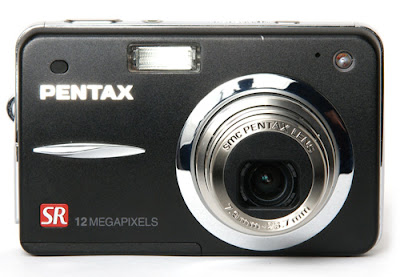 Currently priced at around £190, the Optio A40 is not a cheap camera even when compared to other 12-megapixel compacts. The Fuji F50fd is currently selling for around £143, both the Panasonic FX100 and the Sony W200 are about £165, the Casio EX-Z1200 is just under £170, and even the Nikon S700 is available for under £180. The price of the A40 will undoubtedly come down over the next couple of months as more stock becomes available, but right now it's a very expensive camera.
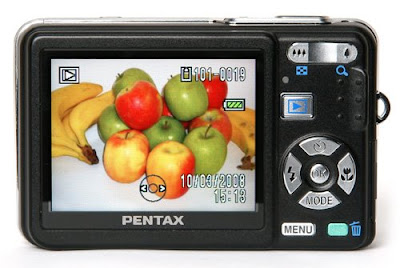 The control layout is basically identical to the Optio A30 and several previous Pentax ultra-compacts. The power button and shutter release are on the top panel, while on the back are the D-pad, playback and menu buttons, the zoom control and the Green Button, the instant easy-mode control found on all of the Optio range. The zoom control is a relatively chunky rocker switch positioned under the right thumb, but it is stiff enough that it isn't easy to operate it accidentally. It's not the most sensitive control in the world though, and the zoom is stepped with seven positions from wide to telephoto, so precise framing is going to mean some moving backwards and forwards.
 Pentax's moving-sensor image stabilisation system is well-proven, and I found I was able to take sharp hand-held shots at full zoom at 1/25th of a second, a gain of about two and a half stops. This is approximately the same performance and Panasonic, Canon and Sony's optical image stabilisation systems.
 Image quality has never been a major problem for Pentax's high-spec cameras, and here the A40 shows its class. Focusing, exposure metering and colour reproduction are all excellent. The lens quality is also up to Pentax's usual high standard, with superb sharpness from edge to edge and no chromatic aberration. It does produce some barrel distortion at both ends of the zoom range, but it is fairly even. Noise control is about average for a 12MP compact camera, with very good picture quality up to 200 ISO, and then progressively lower quality from the just-about-printable 400 ISO to the pretty ugly maximum of 1600 ISO. With the Dynamic Range Adjustment set to strong or automatic, the A40 coped very well with high contrast lighting, keeping a good amount of shadow detail and not too many blown highlights.


